
Polkadot Just Cut Its Inflation in Half
- Views: 66

This post was originally published on this site
Here Is What Happens Next.
Bitcoin traders know the feeling. A halving arrives, supply tightens, and for a few weeks the market debates whether it matters. Then price starts moving and everyone decides it matters a lot. Polkadot is about to find out if the same logic applies to a network-level issuance cut.
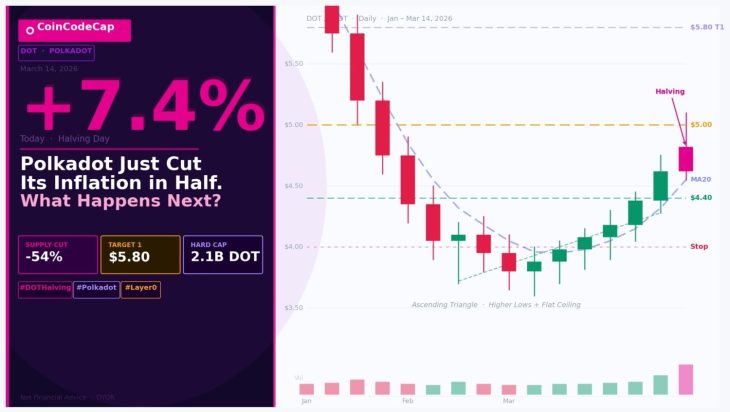
On March 14 – today – Polkadot’s Referendum #1710 takes effect. Annual DOT issuance drops from 120 million tokens to approximately 55 million. Inflation falls from 7.5% to 3.3%. A hard supply cap of 2.1 billion DOT is established. And the staking unbonding period shrinks from 28 days to 24-48 hours – a structural change that quietly makes DOT dramatically more liquid. The vote passed with 81% approval. The market, so far, has only partly priced it in.
For on-demand analysis of any cryptocurrency, join our Telegram channel.
What the Polkadot Halving Actually Changes
Supply shock with a liquidity bonus
Most supply-reduction events cut issuance and leave everything else alone. Polkadot’s referendum did something smarter: it bundled the inflation cut with a staking unbonding reduction. Previously, stakers had to wait 28 days to exit their DOT position. That friction kept institutional capital at arm’s length. At 24-48 hours, the barrier is almost entirely gone.
The combination is meaningful. Less new supply entering the market each week. More flexible access for large participants who cannot tolerate a month-long exit window. Those two things together have historically been a precondition for sustained institutional accumulation.
KEY DATA – March 14, 2026
> Price: $4.82 | 24H: +7.4% | Market Cap: ~$7.4B
> Annual issuance cut: 120M -> ~55M DOT (-54%)
> Inflation rate: 7.5% -> 3.3%
> Hard cap introduced: 2.1 billion DOT
> Unbonding period: 28 days -> 24-48 hours
> Referendum approval: 81% | Futures OI: $42.1M
> Funding rate: 0.0100% (not yet crowded long)
Entry: Current levels or pullback to $4.40-$4.60 support – Stop: Close below $4.00 – Target 1: $5.80 – Target 2: $7.20 – Risk: Moderate – event not fully priced, OI relatively low
The Chart Setup Going Into the Halving
DOT has spent the past six weeks forming a series of higher lows against a persistent resistance band around $5.00-$5.20. That pattern – rising floor, flat ceiling – resolves in one direction eventually. The halving is the catalyst most traders have been waiting for to call the direction.
Price Pattern Chart – DOT / USDT Daily – Jan 2026 to Mar 14, 2026
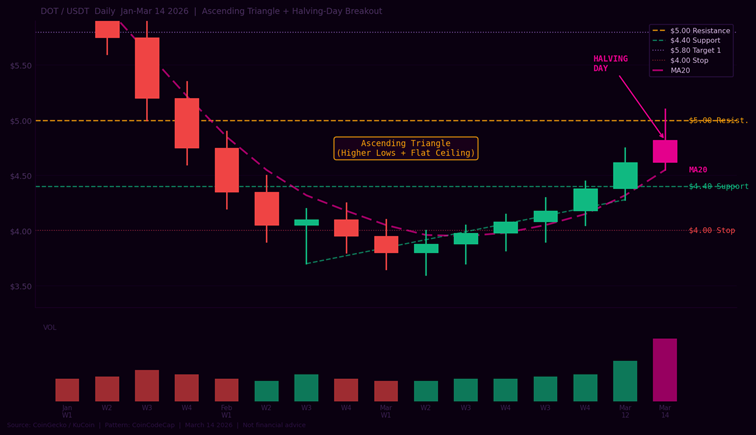
The funding rate at 0.0100% tells you the market is not yet crowded on the long side. That matters. Crowded longs before a catalyst event tend to produce sell-the-news reactions. A neutral funding rate suggests the majority of the move may still lie ahead rather than already being priced into leveraged positions.
Three Things Working in DOT’s Favour Right Now
> The halving is real, on-chain, and already passed governance with 81% approval. It is not speculative – it executes today. Supply reduction at the protocol level is the cleanest fundamental catalyst available in crypto.
> Unbonding at 24-48 hours removes a major institutional adoption barrier. Risk desks that could not justify a 28-day lockup can now model DOT like any other liquid asset. That reopens a capital allocation category that had been closed.
> DOT is still 84% below its November 2021 all-time high of $55. The recovery trade has significant runway before approaching historical resistance levels. That asymmetry is what makes the risk-reward attractive at current prices.
The Honest Risk Picture
Halving events do not always produce immediate price appreciation. Bitcoin’s post-halving moves have typically taken 6-12 months to fully develop. Polkadot’s halving is a supply event, not a demand event – and demand is what actually moves price. If broader crypto sentiment turns risk-off before DOT attracts new buyers, the reduced inflation narrative will not be enough on its own.
The $42.1 million in futures open interest also tells you this trade is not yet crowded – but that cuts both ways. It means the market has not front-run this heavily, which is good. It also means institutional positioning is still light, which means the demand catalyst is still theoretical rather than proven.
Signal Summary
For on-demand analysis of any cryptocurrency, join our Telegram channel.
You Might Like