The Worst Game on the Horizon Store Now Runs Better Than Any Other on Quest 3
- Views: 4

This post was originally published on this site
The Unity Cube is an objectively terrible game (it’s literally just a floating cube, after all) that was built to test the limits of what Quest content Meta would allow into its uncurated App Lab program. After Meta dissolved App Lab, The Unity Cube moved to the main Horizon store and showed that Meta would stay truly hands-off when it came to the scope or quality of what’s listed in its VR game store. The experiment continues to prove its worth; The Unity Cube has now been updated to give users a way to experience Quest 3’s newly unlocked 207Hz refresh rate.
Update (September 2nd, 2026): The Unity Cube’s latest update allows the game to tap into the newly unlocked 207Hz refresh rate of Quest 3. If you have a Quest 3 and are running Horizon OS 2.7, you’ll be able to experience the fluidity of 207Hz, which is nearly three-times as fast as the average Quest game which generally runs at 72Hz. As far as we know, The Unity Cube is the first fully published Quest game with this capability.
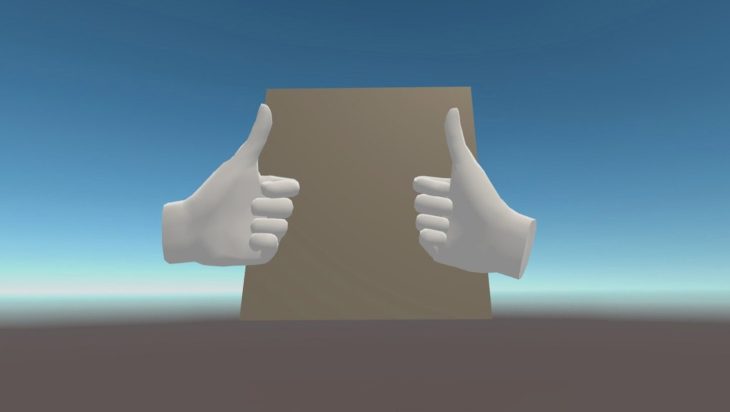
And it might even remain that way for quite some time. Although Quest 3 can now technically run up to 207Hz (or even 240Hz with developer access), actually matching a game’s framerate to such a high refresh rate is extremely difficult with the limited processing power of a standalone headset. But The Unity Cube is up to the task, thanks to it rendering only a single 3D asset (well, three actually, if you count your hands).
The Unity Cube developer Tony “SkarredGhost” Vitillo documented the process of updating the app to enable the 207Hz mode, and shared some thoughts on what the jump in refresh rate actually feels like:
“It’s hard to describe the feeling: you feel like the virtual world is more reactive; it’s smoother. The first time you try it, it even feels a bit weird because you are not used to it: it is a bit like trying VR under a heavy dose of caffeine. Then the more you play with it, the more you get used to it. The virtual reality feels more real, more reactive. When you get back to 72Hz again, it feels like things are like “scattering”. You understand how immersive these framerates are when you go back to the normal 72Hz and you think that VR is not smooth, is more limited.”
Read on to learn more about the origins of The Unity Cube.
Original Article (August 26, 2024): For a long time the only official way to distribute an app on Quest was to submit it to Meta for manual review. But Meta would only accept applications which met opaque quality criteria, like how much content the app offered and whether it was appropriately polished. This made it difficult for developers to get smaller or experimental apps in front of the Quest audience, leading to significant developer outcry for a more open process.
That prompted the creation of ‘App Lab’, an alternative distribution approach for Quest which allowed developers to submit applications for distribution without any judgement on quality or scope. But it came with the caveat that App Lab apps wouldn’t be shown in the main Quest store, leaving it up to developers to point their audience to the app’s page.
To test whether Meta was going truly hands-off when it came to the quality of App Lab apps, developer Tony “SkarredGhost” Vitillo created The Unity Cube.

As the name implies, the app is simply a blank Unity environment with a grey cube—that you can’t even interact with. Even at the great price of free, this app would have never stood a chance of making it onto the main Quest store. But could it make it onto App Lab?
Indeed, Meta allowed The Unity Cube into App Lab, proving it would let just about anything into the program, as long as technical requirements were met and content guidelines were respected (ie: no adult or illegal content).
It was good news that developers could submit any app to App Lab for distribution on Quest without worrying that Meta would block an app on the grounds that it wasn’t complete or polished enough. But sentiment remained that having this ‘unlisted’ Quest store made it unnecessarily difficult for developers to find customers.
After several years of App Lab, developer pressure finally pushed Meta to dissolve the program, ultimately merging the App Lab store with the main Quest store. This meant anyone could submit an app of any quality to the main Quest store where it would be visible to customers through browsing and searching.
Last week The Unity Cube completed its journey and became listed on the main Quest store, along with other App Lab apps, again proving that Meta would be truly hands-off on curation.
And though it’s still possible for developers to mark their Quest apps as “Early Access”—to tell customers to expect something experimental or incomplete—The Unity Cube’s creator joked that “it’s not even in Early Access because it is perfect as it is!”
The post The Worst Game on the Horizon Store Now Runs Better Than Any Other on Quest 3 appeared first on Road to VR.
You Might Like