The investment and development community are constantly striving to find the next profitable sector in XR, turning to new business opportunities following a turbulent time in the consumer VR gaming space. One area of interest is in out-of-home XR attractions, known widely in the industry as Location-Based Entertainment (LBE) XR. The sector deploys XR as a B2B2C business model that aims to surpass expectations of consumer gaming, presenting XR technology to a wider audience.
Guest Article By Kevin Williams
Kevin Williams is a specialist in the immersive location-based entertainment sector, with a long history of development, application, and commentary on the international industry. Along with running his consultancy KWP, working with leaders in the sector, he also is a prolific writer, publishing his own news service on the sector the Stinger Report, and podcast, SoundOff covering trends in the market. He also presents keynotes at numerous conferences on the deployment and application of immersive tech in the out-of-home entertainment sector, and the growth in social entertainment.
Out-of-home XR applications are now seen as revenue vehicles for prominent Intellectual Properties (IP) to reach new audiences. The latest generation of VR free-roaming arena systems offer players premium experiences within high-end virtual recreations of popular properties. Recently announced, Jumanji: The Lost Levels has been developed by Zero Latency in collaboration with Sony Pictures. The premium VR experience will go live across over 170 venues in December this year. This new IP-based property and other games for these systems focus on the social experience, rather than just blasting zombies.
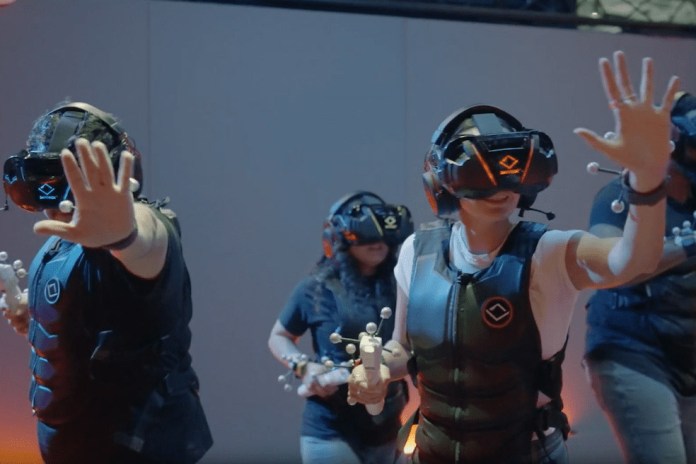
Another VR free-roaming arena developer is Sandbox VR has grown to some 90 venues internationally. Sandbox is the second largest of the standalone franchise operations. In these VR experiences, groups of six players don both VR headsets and haptic vests within an arena which includes added environmental effects. The company has a selection of VR experiences, some including high profile IP-based content such as their popular Squid Game Virtual, developed in partnership with Netflix, along with Stranger Things: Catalyst. Both place guests in virtual recreations of elements from the popular series. Road to VR‘s Ben Lang wrote last year about his first-hand experience inside of Squid Game Virtual and other Sandbox experiences.
Courtesy Sandbox VR
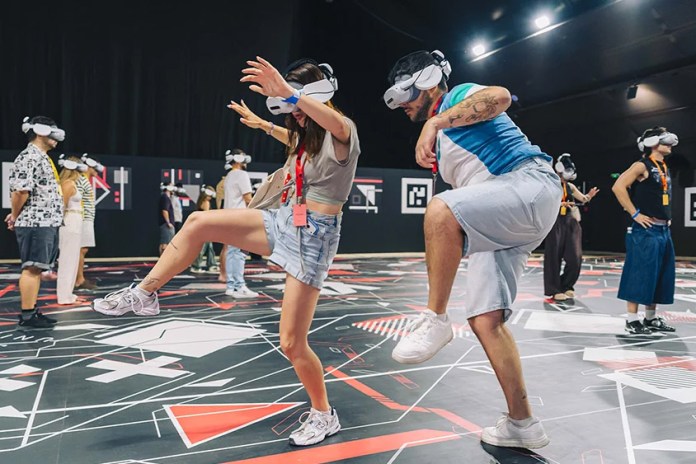
The next generation of VR free-roaming experiences are moving from small handfuls of players to audiences of 20 or even 40 at a time, which have been described as ‘Virtual Adventure’ systems. Audiences traverse recreations of historical environments such as ancient Rome, climb the Pyramids, or navigate the Titanic.
One example of the virtual adventure approach has been developed by the VR studio Univrse in partnership with Banijay Live Studio. The Black Mirror Experience is a travelling 50-minute hybrid adventure within the dystopia environment from the original television series that came from both Channel 4 and was screened on Netflix.
Courtesy Black Mirror Experience
The growth of investment in LBE XR was seen during this years’ Augmented World Expo (AWE), held in Long Beach, California during June. Which included a new LBE XR Zone on the show floor, and a dedicated seminar program where developers and investors attended to scope out this emergent opportunity.
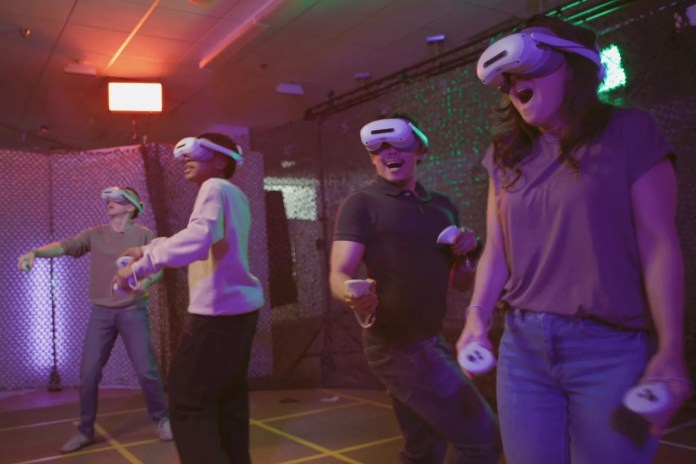
The seminar covered developers in this sector of the market like The Rabbit Hole VR, which worked with developer vrCAVE to offer its latest multiplayer VR free-roaming escape game Cyberscape, where players work together as teams in a compelling escape game experience. Hololabs Studio is another developer of standalone VR free-roam games and recently launched their new experience called Abyss Vault in partnership with Synthesis VR who is a major content distributor and platform developer. Meanwhile, developers such as Octopod VR and Vertigo Games have worked to position some existing consumer VR content into the VR arcade space.
Courtesy Hololabs Studio
Experiences in the LBE XR scene employ share many design considerations seen in the broader theme park and attraction market. Developer Thousand Bit has created Sinister Inn, which has been called “the World’s first Haunted Walkthrough VR attraction.” The concept mixes elements from traditional horror attractions with a portable VR configuration, making an attractive package which requires significantly less physical infrastructure and actor talent compared to a more traditional horror attraction.
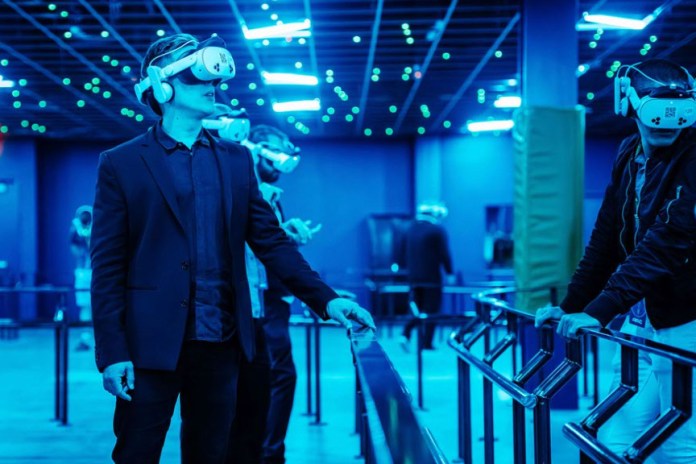
LBE XR has plenty of overlap with consumer XR, but diverges in some interesting ways, especially when it comes to VR headsets. While Meta Ques has long dominated the consumer headset market, many VR entertainment applications are adopting new PICO 4 Ultra VR headset. It has becoming a workhorse system across the industry, thanks to its LBE-focused service, support, and swappable battery. While the PICO platform is not available for consumers in the West, the hardware has been deployed in Western LBE.
Other developers in this sector have relied on the HTC VIVE range of headsets, with a smaller number relying on Meta Quest headsets. Most of the Enterprise LBE XR applications surpass the graphical limitations of consumer standalone headsets, often by using PC VR rendering with wireless delivery.
Another need that’s unique in LBE XR is equipment that’s robust enough to support high usage, especially where hygiene is important. Cleanbox Technologies has emerged as a leading name in hygienic solutions with their unique UV light sanitisation process that’s used widely in this space.
Similar to the consumer side, LBE XR has also begun to adopt mixed reality experiences. Developers like Dreampark offer an MR attraction using Quest 3 headsets in pass-through mode. Their latest experience is a magical game called Wizards Way, in which players see and navigate the real world around them while interacting with virtual elements using their wand controller.
The company has also been working on popup installations of their DreamBox self-service headsets vending kiosk. The self-guided MR attraction is currently on trial at the Hollywood, CA location of popular family entertainment venue Dave & Buster’s.
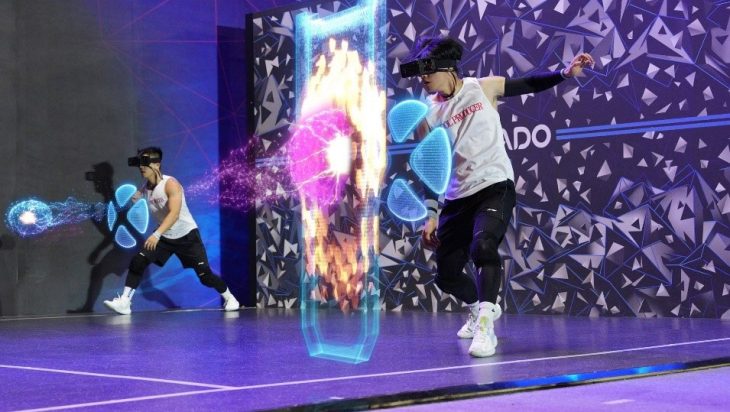
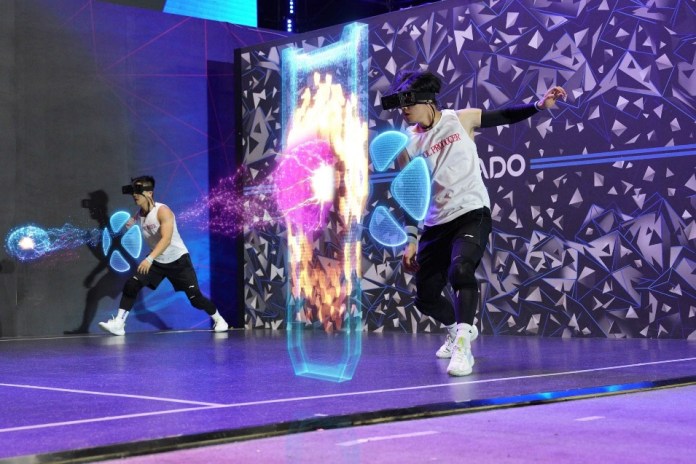
Mixed reality as a spectator technology has also made an appearance in the LBE XR space. Developers such as Meleap with their HADO competitive virtual sports platform. Players wear headsets and wrist sensors to launch virtual energy balls, raise shields, dodge attacks, and compete on a real court in real-time. The platform is played by millions globally, supported by a strong tournament following in Asia, with big prize competitions streamed live with mixed reality visuals shown to competitors, making this one of the first large scale virtual sports platforms.
Courtesy HADO
While there’s many recent exciting developments in the space, success is never guaranteed, even among well qualified entrants. This was illustrated recently by Interstellar ARC, an award-winning virtual experience developed by veteran VR studio Felix & Paul. The experience was made as a VR arena attraction to captivate a large audience within a sci-fi immersive narrative. The attraction opened in 2025 at AREA15 in Las Vegas, Nevada, but was only operational for 10 months before the venue ceased ticket sales and eventually closed, which coincided with layoffs and a likely closure of Felix & Paul Studios. A mixture of a difficult attraction to explain to prospective guests, along with the high operational fees of running the attraction at the Las Vegas venue, doomed this experience.
Courtesy Interstellar ARC
Consumer VR developers looking to pivot from home VR content toward LBE should know that the two mediums are different enough that crossing the boundary requires considerable care. The most popular consumer VR games are rarely are good fit for the unique operational needs of LBE without considerable modification. And even designing brand new content for the LBE space can prove difficult if a studio’s expertise is grounded in the consumer VR space.