
ETH Beats BTC for First Time in 2026: Is Capital Finally Rotating to Ethereum?
- Views: 1


This post was originally published on this site
Ethereum is beginning to quietly reclaim ground against Bitcoin – and the shift, while still early, is becoming difficult for markets to ignore.
For the first time this year, Ethereum has started to outperform Bitcoin on a relative basis, pushing the ETH/BTC ratio toward 0.0306, its highest level in months. At the same time, Bitcoin trades near $74,583 (+5.09% weekly) while Ethereum hovers around $2,283 (+4.1%), reflecting a broader market recovery. Yet beneath these headline numbers lies a more nuanced story: capital may be starting to rotate slowly but meaningfully, toward Ethereum.
The key question now is whether this marks the beginning of a sustained shift, or simply another short-lived divergence in an otherwise Bitcoin-led cycle.
A Subtle but Important Shift in Market Leadership
The ETH/BTC ratio is often described as crypto’s internal compass. Rather than measuring absolute gains, it captures where capital is flowing within the ecosystem.
After falling to ~0.028 earlier in 2026, the lowest level since the pre-DeFi era of 2020, the ratio has now rebounded above 0.030, signaling that Ethereum is beginning to recover relative strength.
This move matters because it tends to precede broader changes in market structure. Historically, sustained uptrends in the ETH/BTC ratio have aligned with periods where:
- Capital rotates into altcoins
- Ethereum ecosystem activity accelerates
- Risk appetite increases across crypto
However, context remains critical. Ethereum is still far from reclaiming its former dominance:
- ETH/BTC ratio: ~0.031 today vs ~0.053 one year ago
- ETH dominance: ~10.4%, down from ~18%
- BTC dominance: ~58%, significantly higher year-over-year
This makes the current move less of a confirmed trend—and more of a potential inflection point.
Analysts broadly agree on key thresholds:
- 0.035: First meaningful confirmation level
- 0.040: Structural rotation signal
Until those levels are reclaimed, the market remains in a transition phase rather than a full rotation cycle.
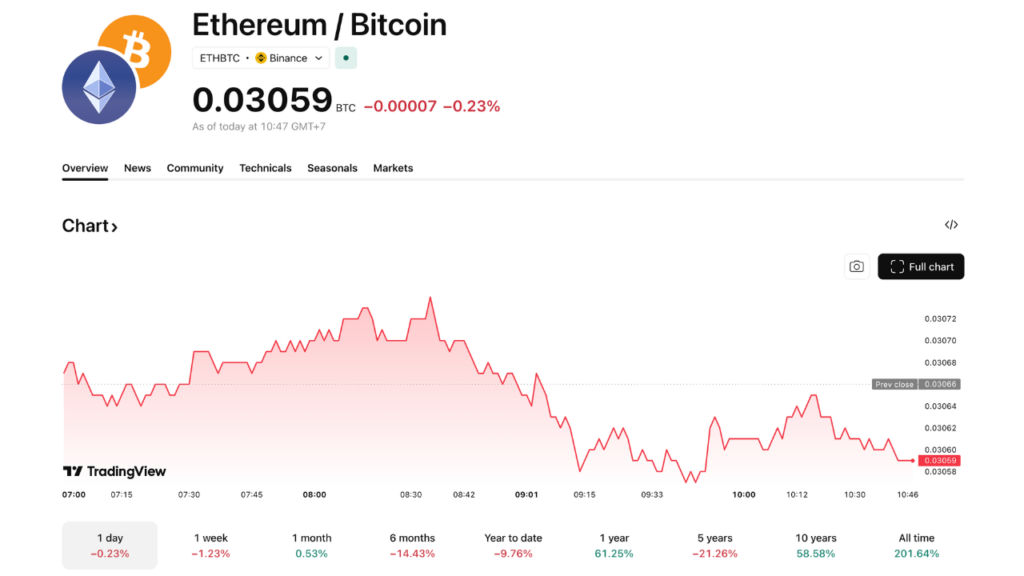
ETH/BTC Ration Chart (Source: TradingView)
Why Ethereum Is Starting to Outperform
Ethereum’s relative strength is not accidental – it is the result of several overlapping dynamics that have converged over the past two weeks.
Oversold Conditions Created a Strong Rebound Setup
Ethereum entered April in a significantly weaker position than Bitcoin. While BTC remained relatively close to its highs, ETH was still down more than 50% from its 52-week peak.
This imbalance created a compression effect. When macro sentiment improved, Ethereum had more room, and more urgency – to rebound.
Short Positioning Amplified the Move
Derivatives data shows that Ethereum had built up substantial short exposure prior to the rally. Funding rates turned negative across major exchanges, indicating that traders were positioned for further downside.
When markets flipped risk-on, helped by geopolitical headlines and broader crypto inflows, these short positions were forced to unwind.
The result: a short squeeze that accelerated ETH’s upside relative to BTC, even though both assets were rising.
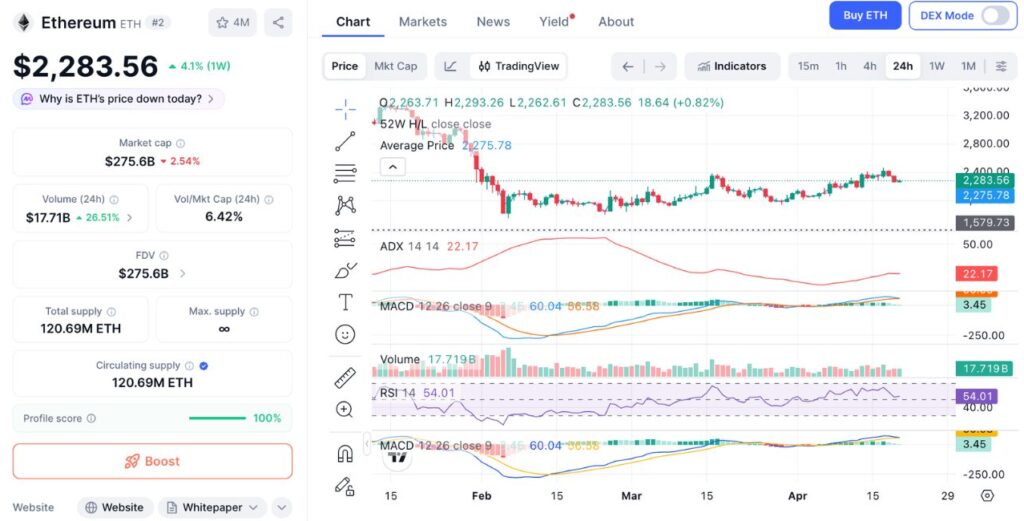
ETH 24H Price Chart (Source: CoinMarketCap)
On-Chain Data: Whales Are Quietly Accumulating
Beyond price action, on-chain metrics are painting a more constructive picture for Ethereum.
According to Santiment data, the number of wallets holding 100,000 ETH or more has increased from 54 to 57, signaling renewed accumulation by large entities.
This matters because:
- These wallets represent hundreds of millions of dollars in capital
- Their behavior tends to reflect longer-term conviction rather than short-term speculation
Historically, increases in large-holder accumulation have preceded periods of price expansion and sustained upward momentum.
At the same time, Ethereum’s network activity is strengthening:
- Daily transactions have climbed to ~3.6 million (+41% week-over-week)
- Institutional and DeFi-related activity continues to expand
However, there are important caveats. Despite higher activity, stablecoin transfer volume has dropped sharply, and network fees have declined by nearly 50%. This suggests that while usage is increasing, the economic value of that activity may be weakening – a trend tied closely to Layer 2 adoption.
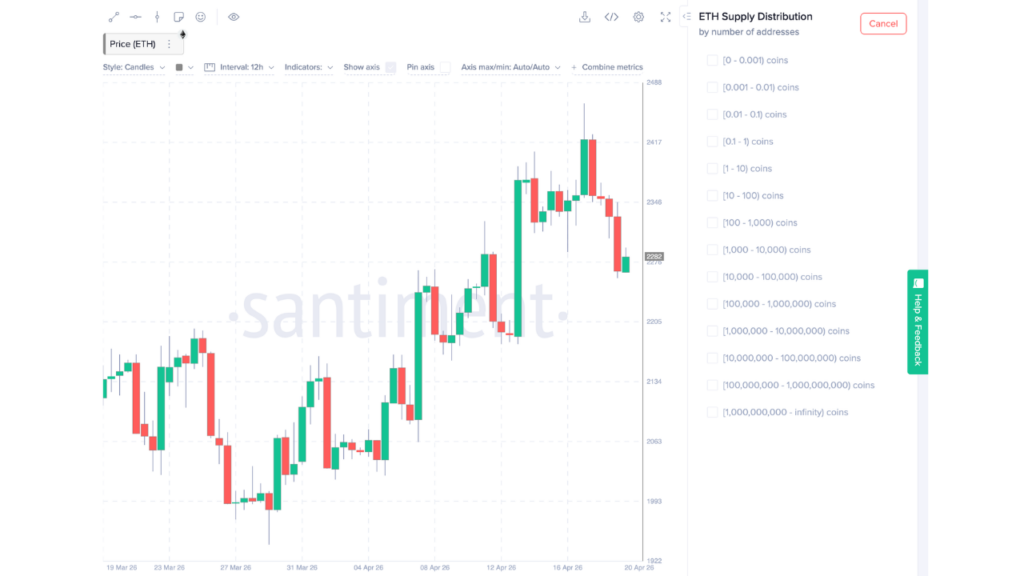
The number of wallets holding at least 100,000 ETH increased to 57 within a week (Source: Santiment)
Institutional Flows Are Beginning to Diverge
Perhaps the most closely watched signal of a potential rotation is emerging from institutional capital flows, but the latest data suggests a more nuanced picture than a simple shift away from Bitcoin.
Recent figures show that Bitcoin ETFs continue to dominate inflows, attracting approximately $663.9 million, while Ethereum ETFs brought in around $127.4 million over the same period. At the aggregate level, total crypto ETF inflows stand at roughly $818 million, underscoring sustained institutional demand across the asset class.
Rather than signaling a clear rotation out of Bitcoin, this distribution suggests something more subtle: institutions are beginning to diversify exposure, not replace it.
Bitcoin remains the primary gateway for large-scale capital allocation, reflecting its role as the market’s macro anchor and liquidity hub. However, Ethereum’s steady share of inflows, particularly during a period of improving relative performance, indicates that it is increasingly being treated as a secondary core allocation, rather than a peripheral bet.
This shift is important. Historically, when capital expands beyond Bitcoin into Ethereum, it often marks the early stages of broader market risk expansion, even if Bitcoin continues to lead in absolute terms.
Ethereum’s growing appeal lies in its evolving investment profile. Unlike Bitcoin, which is primarily positioned as a store of value, Ethereum offers both price exposure and embedded yield dynamics. The emergence of staking-enabled ETF products, such as BlackRock’s ETHB, reinforces this positioning by delivering approximately 3.1% annual yield alongside underlying asset exposure.

Crypto ETFs Flow Chart (Source: Coinglass)
A Narrative Shift Is Taking Shape
At a deeper level, the ETH vs BTC dynamic reflects a broader shift in how the market values crypto assets.
- Bitcoin is increasingly treated as digital gold – a store of value tied to macro conditions
- Ethereum is evolving into a digital economy layer – a platform for applications, finance, and tokenized assets
This distinction drives capital behavior.
When markets are cautious, Bitcoin tends to dominate. When confidence returns, investors often seek higher growth—and that capital flows into Ethereum.
The current environment suggests the market is beginning to tilt back toward growth, even if cautiously.
Technical Structure Supports the Case – With Conditions
Ethereum’s chart structure is also improving.
The asset recently broke above $2,385, completing an ascending triangle pattern and reclaiming its 100-day moving average – a key medium-term trend signal.
Important levels to watch:
- Support: $2,385 (former resistance)
- Confirmation: Daily close above $2,480
- Upside targets: $2,700 → $2,900
As long as ETH holds above its breakout zone, the structure remains constructive. However, failure to sustain momentum could quickly shift sentiment back toward consolidation.
Catalysts That Could Drive a Real Rotation
Ethereum’s trajectory in Q2 will likely depend on whether upcoming catalysts can sustain momentum.
Glamsterdam Upgrade (Expected June 2026)
This upgrade is expected to significantly improve network efficiency:
- Gas limit increase from 60M to 200M
- Throughput targeting ~10,000 transactions per second
- Fee reductions of up to ~78%
Historically, Ethereum upgrades generate anticipatory rallies, often beginning months before deployment.
Institutional DeFi Expansion
Ethereum continues to dominate institutional blockchain adoption.
- JPMorgan’s Onyx platform processed over $900 billion in tokenized transactions in 2025
- Major firms like Franklin Templeton and HSBC are expanding tokenized asset offerings
If lower fees bring more activity back to Ethereum’s mainnet, demand for ETH could strengthen structurally.
Why Caution Is Still Warranted
Despite improving signals, several structural risks remain.
Bitcoin Dominance Remains Elevated
At ~58%, Bitcoin’s dominance reflects continued institutional preference. This trend tends to shift slowly, not abruptly.
Layer 2 Growth Dilutes Fee Capture
Ethereum’s scaling success is also a challenge.
Layer 2 networks like Arbitrum and Base increase usage, but capture much of the economic value, leaving the base layer with reduced fee revenue.
Ethereum’s daily fees remain ~70% below 2024 highs, raising ongoing questions about valuation.
Macro Risks Haven’t Disappeared
Recent gains were partly driven by geopolitical optimism. If those conditions reverse, through renewed tensions or rising energy prices, risk assets like ETH could quickly lose momentum.
So, Is Capital Rotating to ETH?
The evidence suggests that early-stage rotation may be underway, but it is not yet confirmed.
What we are seeing:
- Increasing institutional inflows into Ethereum
- Whale accumulation on-chain
- Improving technical structure
- Relative strength vs Bitcoin
What is still missing:
- Sustained breakout in ETH/BTC above 0.035
- Decline in Bitcoin dominance
- Strong recovery in Ethereum fee generation
In short, this is a developing trend – not a completed shift.
Final Thoughts
Ethereum outperforming Bitcoin for the first time in 2026 is more than a statistical milestone – it is a signal that market dynamics are evolving.
The crypto market is testing whether Ethereum can reassert itself as the primary growth engine, rather than remaining in Bitcoin’s shadow.
If momentum continues – supported by institutional flows, network upgrades, and sustained relative strength – this could mark the early stages of a broader capital rotation cycle.
But for now, the market remains balanced between two forces:
- Bitcoin’s dominance and stability
- Ethereum’s resurgence and growth potential
The coming weeks will determine which narrative takes control.
Because in crypto, rotation isn’t defined by a single move – it’s confirmed by persistence.
The post ETH Beats BTC for First Time in 2026: Is Capital Finally Rotating to Ethereum? appeared first on NFT Plazas.
You Might Like