
Galaxy Expands AI Data Center Footprint With 500-Acre Texas Campus
- Views: 1

This post was originally published on this site
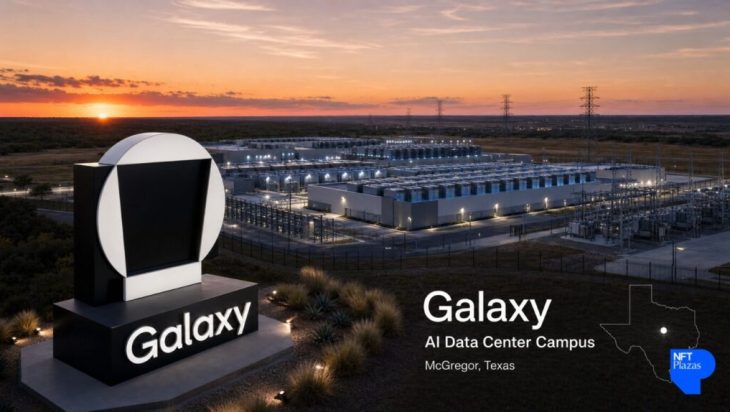
Galaxy said on July 28 that it has acquired approximately 500 acres of land in McGregor, McLennan County, Texas, under a development agreement with the City of McGregor, to build and operate a data center campus serving artificial intelligence and high-performance computing in the McGregor Industrial Park.
This marks Galaxy’s second major data center investment in Texas, following its Helios campus in West Texas. The project shows that the company is expanding further into AI infrastructure, amid rapidly growing compute demand and intensifying competition among data center developers for land, power, and deployment speed.
Galaxy is expanding its data center footprint. We’ve executed a development agreement and acquired 500 acres in McGregor, Texas, for the construction and operation of an AI and HPC data center campus.
Galaxy is advancing the electricalinfrastructure required to support the… pic.twitter.com/FD7l5q8Bb7
— Galaxy (@galaxyhq) July 28, 2026
The McGregor Campus
The McGregor campus is designed as a multi-phase development, starting with 74 MW and with potential for significant expansion once additional transmission infrastructure is completed. Galaxy said the project is being developed with the McGregor Economic Development Corporation and Heart of Texas Electric Cooperative, with which the company has signed service agreements to support required interconnection items.
The first phase is expected to begin receiving power in 2028. If infrastructure timelines progress as planned, Galaxy expects the 500-acre site could expand to a multi-hundred-megawatt scale by 2030, moving McGregor from an initial 74 MW phase into the larger-scale data center asset class within the company’s portfolio.
Galaxy stated the campus will be privately funded, while committing to building its own substation at the site and providing financial assurances as required by the electric utility for related upgrades. For AI data center projects, power, interconnection, and commissioning items often determine operational speed just as much as physical facility construction.
This approach is also intended to mitigate cost impacts on local electricity users. According to Galaxy, its private infrastructure investment and financial assurances are designed to prevent the cost of serving the campus from being passed on to regional ratepayers.
Impact on McGregor
The 500-acre land acquisition brings approximately $7.5 million in land sale revenue to the City of McGregor. Galaxy also estimates that the project will add at least $130 million to the local real estate tax base.
During the construction phase, the project is expected to create jobs for several hundred construction workers and engineering partners. Once operational, the campus will require a permanent team to manage data center operations, maintain power infrastructure, cooling, security, and physical facilities.
Galaxy stated the McGregor campus will utilize a closed-loop cooling system, similar to Helios, to recirculate water internally and reduce water usage compared to water-intensive cooling models. The company also said it will fund additional water infrastructure items under the development agreement.
For McGregor, key indicators in the coming years will be actual tax revenues, long-term jobs, water usage, and the progress of accompanying infrastructure upgrades.
Galaxy’s AI Infrastructure Push
Galaxy is traditionally better known in the digital assets sector, but in recent years has pushed aggressively into AI/HPC infrastructure, particularly through Helios in Dickens County, West Texas. The company acquired Helios in 2022 and converted the campus from a facility tied to bitcoin mining into a large-scale AI/HPC campus.
Helios currently has over 1.6 GW of ERCOT-approved power capacity and holds a long-term lease agreement with CoreWeave, one of the prominent AI cloud companies in the market. On July 6, Galaxy announced it had completed Phase I at Helios, handing over 133 MW of critical IT load to CoreWeave.
Galaxy also announced the pricing of a $3.507 billion offering of senior secured notes to partially fund Helios II, consisting of two buildings with eight data halls in Dickens County. This capital raise highlights the scale of capital required for Galaxy to expand its data center segment alongside its digital assets business.
The addition of McGregor expands Galaxy’s footprint in Texas beyond Helios, the anchor asset of the company’s data center business. If executed according to plan, the new campus will bring Galaxy closer to a multi-site AI/HPC infrastructure model, rather than relying on a single campus.
Execution Risks
Galaxy noted that many project milestones remain subject to development conditions, including permitting, regulatory approvals, construction progress, power interconnection, commissioning, regulatory changes, and AI/HPC market conditions.
For McGregor, the timeline to energize the first phase in 2028 will be the most critical milestone. If interconnection or transmission infrastructure is delayed, the campus’s ramp-up timeline could also be affected. This is an industry-wide risk for data centers, as power demand for AI grows faster than grid expansion and electrical equipment supply chains.
Compute demand can also fluctuate based on investment cycles of hyperscalers, AI clouds, and technology enterprises. Galaxy frames this demand as a structural shift, but multi-hundred-megawatt projects still require long-term contracts, stable tenants, and reasonable capital costs to achieve financial efficiency.
What Comes Next
In the coming period, Galaxy will need to complete permitting, interconnection, and private substation construction steps before the McGregor campus can receive power. The company expects the first phase to begin receiving power in 2028, followed by expansions based on the progress of additional transmission upgrades.
If this progress is maintained, McGregor will mark Galaxy’s next major expansion step following Helios. The project will also demonstrate how effectively the company can turn its multi-site AI/HPC data center strategy into a large-scale business segment.
The post Galaxy Expands AI Data Center Footprint With 500-Acre Texas Campus appeared first on NFT Plazas.
You Might Like