
KelpDAO Completes Final rsETH Transfer to LayerZero Lockbox as Recovery Phase Concludes
- Views: 2


This post was originally published on this site
KelpDAO has finalized the operational phase of its rsETH recovery plan, transferring the last tranche of tokens into its cross-chain adapter and restoring full bridge coverage — but the harder work of rebuilding user trust may still lie ahead.
KelpDAO announced on May 25 that it has completed the operational phase of its rsETH recovery plan, transferring a final tranche of 20,373.72 rsETH into the protocol’s Omnichain Fungible Token (OFT) adapter. The move marks the culmination of a multi-week replenishment effort that saw roughly 116,000 rsETH returned to the rsETH OFT adapter over approximately two weeks, carried out with the support of Aave, one of DeFi’s largest lending protocols.
The completion of the transfer is being presented by KelpDAO as a milestone in restoring confidence around rsETH’s cross-chain backing infrastructure — a system that sits at the heart of how the liquid restaking token operates across multiple blockchain networks.
What Is the rsETH OFT Adapter?
The rsETH OFT adapter is a core piece of infrastructure within KelpDAO’s architecture. It manages cross-chain liquidity and token movement across supported networks, enabling users to move rsETH between blockchains through the LayerZero and Chainlink bridge protocols. When the adapter’s reserves fall below the value of tokens circulating on external chains, the protocol’s redemption guarantees come into question — a scenario that can rapidly erode user confidence in a liquid staking or restaking asset.
The refill process that KelpDAO undertook over the past two weeks was designed to address exactly that concern, restoring the adapter’s reserves to a level that matches or exceeds outstanding cross-chain liabilities.
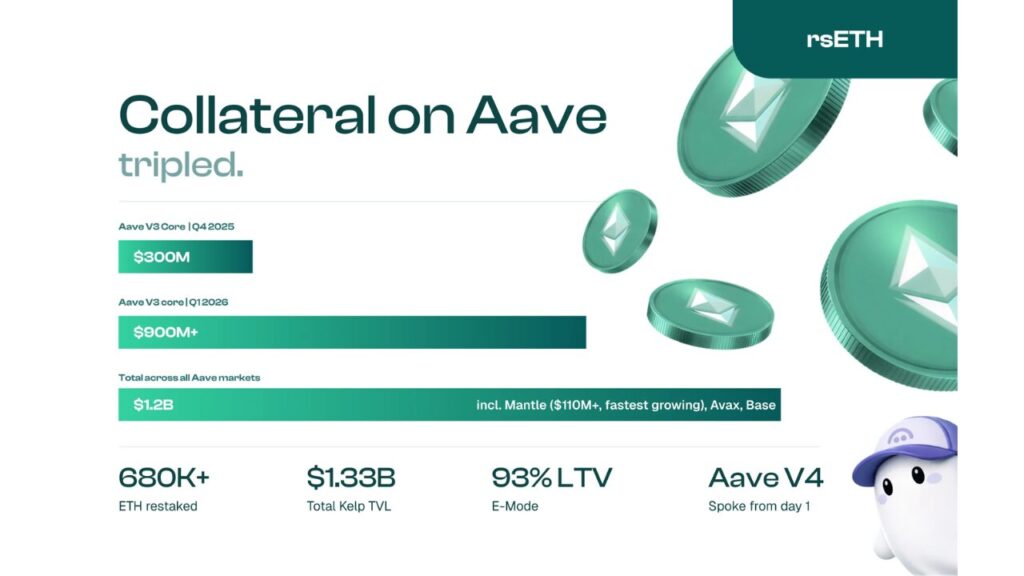
Kelp Q1 2026 Report (Source: KelpDao)
Backing Ratio Now Above 100%
According to KelpDAO’s live rsETH dashboard, the protocol currently shows a 100.01% ETH backing ratio, along with full bridge lockbox coverage across both its LayerZero and Chainlink infrastructure. The figures are intended to demonstrate that rsETH has remained fully backed since the system was unpaused following the earlier disruption.
KelpDAO also confirmed that minting, redemption, and reward operations have been functioning normally since the system resumed. For users holding rsETH or relying on it as collateral within DeFi protocols, those operational metrics matter as much as the backing ratio itself — they indicate that the protocol’s core functions are operating without restrictions.
The use of a publicly accessible, real-time dashboard to communicate the recovery status reflects a broader trend across DeFi, where protocols under scrutiny have increasingly turned to on-chain transparency tools as a primary mechanism for reassuring users and counterparties.
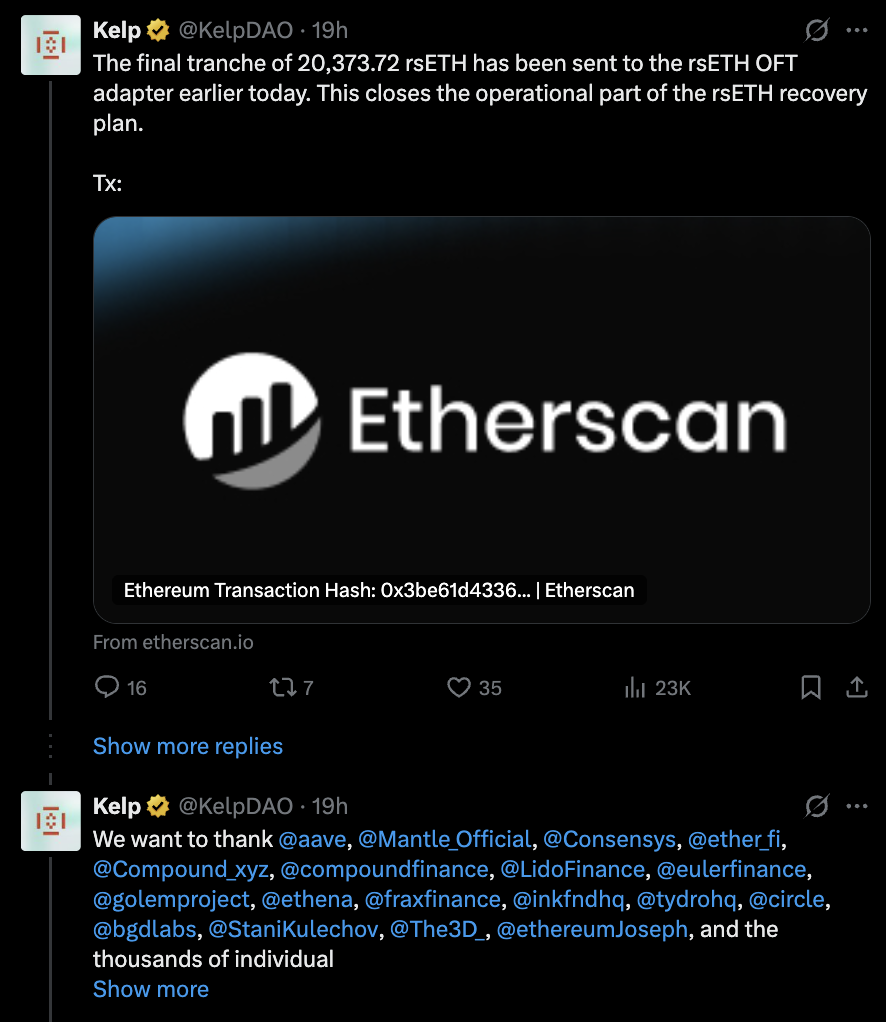
KelpDAO Completes Final rsETH Transfer to LayerZero Lockbox as Recovery Phase Concludes
Aave’s Role Highlights DeFi’s Interconnectedness
Perhaps one of the more notable aspects of the recovery process is the involvement of Aave. As one of the most widely used decentralised lending platforms in the ecosystem, Aave’s participation in replenishing the rsETH OFT adapter underscores how deeply intertwined major DeFi protocols have become.
rsETH is used as collateral within Aave markets, meaning any uncertainty around the token’s backing or redemption reliability carries downstream risk for Aave users and liquidity providers. Aave’s active support in the refill process can therefore be understood as both a risk management measure and a signal of institutional confidence in KelpDAO’s recovery framework.
This kind of cross-protocol coordination during periods of operational stress is becoming more common in DeFi, as the interdependencies between lending markets, liquid staking protocols, and cross-chain bridges have grown too significant to ignore.
A Sector Under Scrutiny
The rsETH incident and subsequent recovery take place against a backdrop of heightened scrutiny across the liquid staking and restaking sectors. Over the past year, multiple bridge exploits, custody failures, and infrastructure disruptions have made investors increasingly cautious about the risks embedded in cross-chain token systems.
Protocols operating in this space are now under pressure to demonstrate not only that their assets are fully backed, but that their bridge infrastructure is robust, their reserve data is verifiable in real time, and their recovery processes are transparent and well-coordinated. The growing adoption of proof-of-backing dashboards, publicly trackable recovery wallets, and real-time solvency metrics reflects the industry’s response to these demands.
KelpDAO’s approach — combining a structured operational recovery with live dashboard visibility — appears calibrated to meet those expectations.
From Operations to Confidence
KelpDAO has characterised the latest transfer as the end of the operational recovery phase. The framing is deliberate: the mechanics of the recovery are now complete, and the focus shifts toward the longer-term process of rebuilding trust.
That distinction matters. Completing a technical recovery and restoring user confidence are not the same thing. Users and institutional participants who experienced uncertainty during the disruption will form their own assessments over time, based on whether the protocol’s systems continue to perform reliably and whether communication standards are maintained.
For now, KelpDAO’s metrics tell a clean story: the adapter is fully replenished, the backing ratio is above parity, and operations are running normally. Whether that is sufficient to fully restore the protocol’s standing within the DeFi ecosystem will depend on what comes next.
The post KelpDAO Completes Final rsETH Transfer to LayerZero Lockbox as Recovery Phase Concludes appeared first on NFT Plazas.
You Might Like