
Mt. Gox Moves $739M in Bitcoin During BTC Bleed — Could Prices Crash Back to $60K?
- Views: 2


This post was originally published on this site
The defunct exchange’s largest Bitcoin transfer in months has rattled already nervous markets, raising a question traders can’t stop asking: how low can BTC go?
Bitcoin is bleeding. And the ghost of crypto’s most infamous collapse just showed up at the worst possible time.
On June 2, 2026, Mt. Gox moved 10,422 BTC worth approximately $739 million ahead of its October 2026 creditor repayment deadline, triggering widespread market jitters and contributing to Bitcoin’s drop below $69,000 — despite no confirmed selling activity. The transfer, confirmed by blockchain analytics firm Arkham Intelligence, is the exchange’s largest single movement in months, landing squarely in the middle of one of the worst market stretches of 2026.
What Happened On-Chain
Blockchain data shows the transfer took place in Bitcoin block 952,072 at 04:47 UTC on June 2. Of the total, 10,306 BTC was sent to a new address with no prior transaction history, while 116 BTC was routed to a known Mt. Gox hot wallet. A later transaction moved another 116 BTC to a separate address, along with a small test transfer to a Bitstamp cold wallet.
The split pattern is not accidental. It mirrors earlier administrative transfers that preceded creditor distributions, though none of the coins has yet been forwarded to a custody provider or exchange. In other words: the coins have moved, but they haven’t been sold — at least not yet.
Mt. Gox still holds an estimated 34,504 BTC with a current market value of about $2.43 billion, making it one of the largest unsettled Bitcoin reserves among discontinued cryptocurrency platforms worldwide. Official repayments began in mid-2024, with roughly 19,500 claimants having received funds so far. The process, overseen by trustee Nobuaki Kobayashi, has seen the final deadline postponed twice already — most recently extended by a Tokyo court in October 2025 from October 31, 2025 to October 31, 2026.
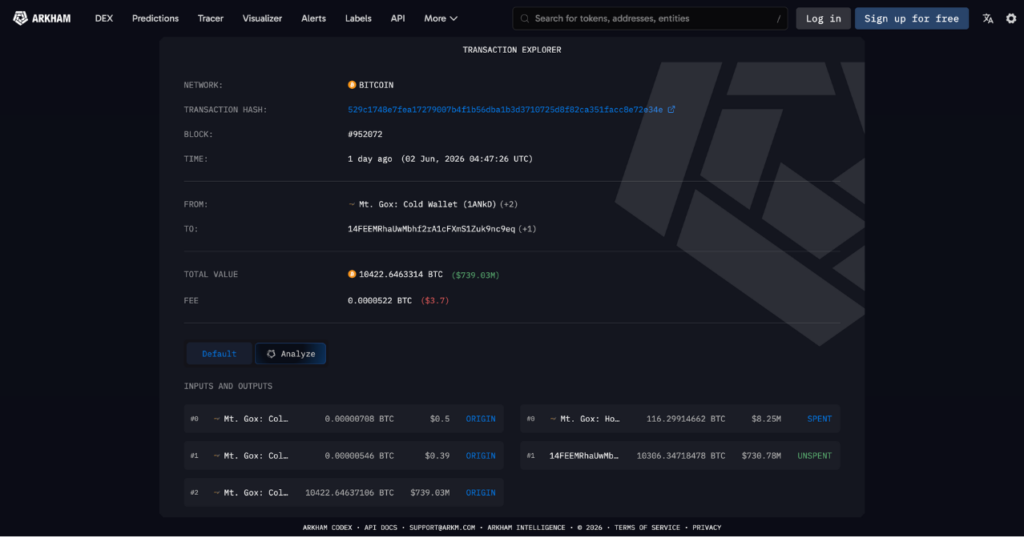
Mt. Gox has moved 10,422 bitcoin worth about $739 million (Source: Arkham Intelligence)
A Familiar Ghost, A New Scare
This isn’t the first time Mt. Gox has spooked the market with a large wallet movement. A November 2025 transfer of 10,608 BTC preceded a 15.54% price drop in just four days and an 11.44% decline over 31 days. By contrast, a November 2024 transfer of 32,371 BTC actually preceded a 34.66% gain in seven days and a 49.15% gain over 30 days. The outcome, it turns out, depends heavily on the broader market conditions the transfer lands in.
Today’s transfer is almost identical in size to the November 2025 movement. More importantly, the market environment it landed in has far more in common with that bearish episode. Bitcoin is pressing toward the 0.618 Fibonacci support at $68,694, the Fear and Greed Index sits at 31, and institutional outflows have been running for three consecutive weeks. There is no comparable macro catalyst on the horizon that could absorb supply the way the 2024 election result did.
A Market Already Under Siege
Mt. Gox’s transfer did not cause the current selloff alone. Bitcoin was already under significant pressure from multiple directions.
Strategy — formerly MicroStrategy — disclosed it sold 32 Bitcoin between May 26 and May 31, fetching an average price of $77,135 per coin for total proceeds of roughly $2.5 million, intended to fund distributions on its perpetual preferred stock program. While the amount was financially trivial, the symbolism was not. For years, Executive Chairman Michael Saylor had promoted a “never sell Bitcoin” philosophy. The decision to sell even a small portion of holdings created uncertainty among investors and contributed to growing nervousness across the market.
Meanwhile, ETF flows — long considered Bitcoin’s most powerful bullish tailwind in 2026 — have turned sharply negative. U.S. spot Bitcoin ETFs recorded roughly $3.45 billion in withdrawals across 11 straight trading sessions through late May, the largest monthly ETF exodus of 2026, with a single session seeing $484 million in redemptions.
Geopolitics added further pressure. The prospect of escalating conflict involving Iran, Israel, and the United States has increased demand for conventional safe havens and weighed on risk assets including crypto.

Strategy Sold Some of Its Bitcoin For the 1st Time in Years
Could BTC Really Hit $60,000?
The question now dominating trading desks and crypto Twitter alike: how far does this go?
If Bitcoin fails to reclaim $71,500, sellers could target $68,700 first, followed by the $66,000–$65,000 range. A stronger breakdown below that zone would put the February demand area near $60,000 back into focus.
Traders watching the $65,000 level as near-term technical support believe a decisive break could potentially open the door to a test of $60,000, but if current levels hold, there could be a setup for a short-term rebound — especially if ETF outflows slow and forced selling exhausts itself.
Further downside toward the $60,000–$64,000 zone remains possible if ETF outflows persist or macro headwinds intensify. On June 3, Bitcoin touched an intraday low near $65,372 before rebounding above $67,000.
Not everyone is sounding the alarm. Bloomberg Intelligence analyst Eric Balchunas pushed back on the panic, noting that $3 billion in outflows from a $100 billion asset base is “totally meaningless” relative to normal ETF flow patterns, and that cumulative net flows since spot Bitcoin ETFs launched remain near $57 billion — an unusually resilient figure for a volatile asset.
On the Mt. Gox overhang specifically, analysts note that the remaining supply is manageable. Since repayments began in July 2024, about 107,311 BTC have been distributed from an original pool of roughly 142,000 BTC, leaving approximately 34,000–35,000 BTC remaining — and many creditors have shown a preference for holding rather than liquidating.
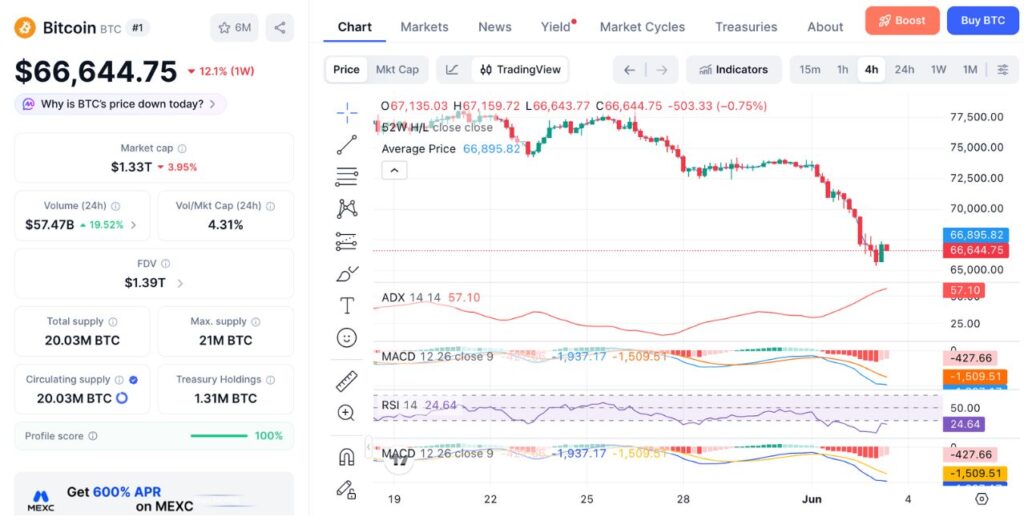
Bitcoin (BTC) Price Chart Today (Source: CoinMarketCap)
The Bottom Line
The current shakeout may ultimately prove to be a healthy consolidation rather than the start of a deeper bear market — but the coming days will be critical in determining whether fear subsides or deepens further. With Bitcoin trading 44% below its all-time high of roughly $126,000 set in October 2025, the market is caught between long-term institutional optimism and short-term fear.
Mt. Gox didn’t create this crisis. But its timing couldn’t have been worse.
The post Mt. Gox Moves $739M in Bitcoin During BTC Bleed — Could Prices Crash Back to $60K? appeared first on NFT Plazas.
You Might Like